§01 TRADE_JOURNAL - PLAYBOOKS¶
· DASHBOARD tab · performance overview
 ¶
¶
What It Shows¶
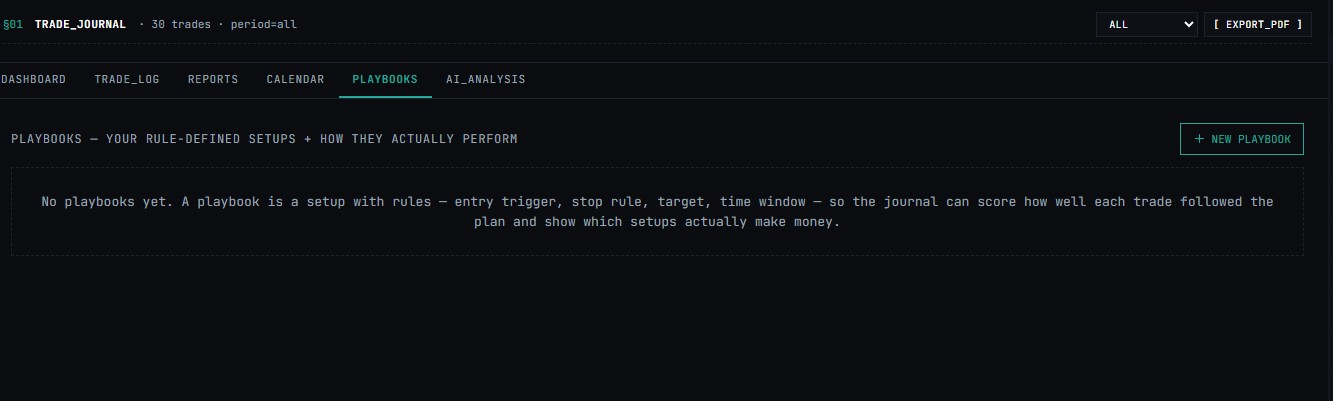
Playbooks — your rule-defined setups + how they actually perform NEW PLAYBOOK No playbooks yet. A playbook is a setup with rules — entry trigger, stop rule, target, time window — so the journal can score how well each trade followed the plan and show which setups actually make money.
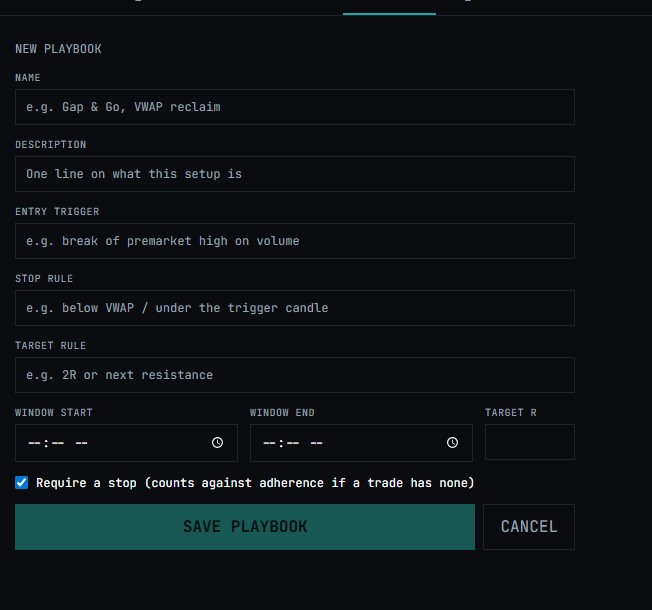
Instead of entering trades randomly, you define:
- What pattern must appear
- When you are allowed to enter
- Where the trade is invalid
- Where you take profit
- What time window the setup is valid
- How much reward you expect compared to your risk
A good playbook helps you stay consistent and makes it easier to review your performance later.
Field-by-field explanation¶
1. Name¶
What it means:
The name of the trading setup.
How to use it:
Choose a short name that clearly identifies the pattern.
Examples:
Gap & GoVWAP ReclaimOpening Range BreakoutLiquidity Sweep ReversalPremarket High Break
2. Description¶
What it means:
A one-line explanation of what this setup is.
How to use it:
Describe the market behavior you are looking for.
Example:
Price gaps up, holds above VWAP, then breaks the premarket high with strong volume.
A strong description should answer:
- What is the setup?
- What market condition does it need?
- Why does the trade make sense?
3. Entry Trigger¶
What it means:
The exact condition that allows you to enter the trade.
How to use it:
This should be specific. Avoid vague entries like “when it looks strong.”
Examples:
- Break of premarket high on high volume
- Reclaim of VWAP after a pullback
- Break and hold above opening range high
- Bullish engulfing candle after liquidity sweep
- Retest of support with strong buyer reaction
Bad example:
Enter when price feels strong.
Better example:
Enter when a 5-minute candle closes above VWAP and volume is above the previous 5-minute candle.
4. Stop Rule¶
What it means:
The price level or condition where the trade is wrong and you exit.
How to use it:
Your stop defines your risk. Before entering, you should know exactly where you will exit if the setup fails.
Examples:
- Below VWAP
- Below the trigger candle low
- Below premarket high after breakout
- Under the most recent higher low
- 1 ATR below entry
- Below support zone
Example:
Stop is below the trigger candle low. If price closes back under VWAP, exit immediately.
5. Target Rule¶
What it means:
The condition or price area where you plan to take profit.
How to use it:
Your target should be based on structure, resistance, risk/reward, or a measured move.
Examples:
- 2R profit target
- Next resistance level
- Previous day high
- Opening range measured move
- Scale out at 1R, final target at 3R
- Prior liquidity zone
Example:
First target is 2R. Final target is the next major resistance level.
6. Window Start¶
What it means:
The earliest time you are allowed to take this setup.
How to use it:
Some strategies work best during specific market periods.
Examples:
09:30 AMfor market open strategies09:45 AMto avoid the first 15 minutes10:00 AMfor VWAP reclaim setups02:30 PMfor power-hour setups
7. Window End¶
What it means:
The latest time you are allowed to take this setup.
How to use it:
This prevents taking a setup when market conditions are no longer favorable.
Examples:
10:30 AMfor opening momentum setups11:30 AMbefore lunchtime slowdown03:30 PMfor afternoon continuation setups
Example:
Only trade this setup between 9:30 AM and 10:30 AM because the setup depends on opening volatility.
8. Target R¶
What it means:
Your expected reward measured in R, where 1R = your risk on the trade.
Example:
If you buy at $100 and your stop is $98, your risk is $2.
- 1R target =
$102 - 2R target =
$104 - 3R target =
$106
Why it matters:
Using R helps you judge trades consistently, regardless of share size or dollar amount.
Typical values:
- Conservative target:
1R - Balanced target:
2R - Aggressive target:
3R+
9. Require a stop¶
What it means:
This checkbox means every trade using this playbook must have a stop rule.
Why it matters:
If enabled, trades without a stop may count against your discipline or adherence score.
Recommended setting:
Keep this checked. A trade without a stop is usually not a complete trading plan.
Example playbook: VWAP Reclaim¶
Name¶
VWAP Reclaim
Description¶
Price loses VWAP, then reclaims VWAP with strong buying volume and holds above it.
Entry Trigger¶
Enter when a 5-minute candle closes above VWAP after previously trading below it, with volume higher than the previous candle.
Stop Rule¶
Stop below the reclaim candle low or below VWAP, whichever is tighter but still gives the trade reasonable room.
Target Rule¶
First target at 2R. Secondary target at the next resistance level or previous high of day.
Window Start¶
09:45 AM
Window End¶
11:00 AM
Target R¶
2
Require a stop¶
Yes.
Example playbook: Gap & Go¶
Name¶
Gap & Go
Description¶
Stock gaps up in premarket, holds above VWAP, and breaks the premarket high with strong volume after the open.
Entry Trigger¶
Enter on break of premarket high with increasing volume and price holding above VWAP.
Stop Rule¶
Stop below VWAP or below the breakout candle low.
Target Rule¶
Take partial profit at 2R and hold remaining shares toward the next resistance level.
Window Start¶
09:30 AM
Window End¶
10:15 AM
Target R¶
2
Require a stop¶
Yes.
Simple formula for R¶
Example¶
Checklist before saving a playbook¶
Before clicking Save Playbook, make sure:
- The setup has a clear name.
- The entry trigger is specific and measurable.
- The stop rule is defined before entry.
- The target rule gives enough reward for the risk.
- The time window matches when the setup works best.
- The Target R is realistic.
- The stop requirement is enabled.
Quick blank template¶
# Playbook Name

## Description
[One-line explanation of the setup]

## Entry Trigger
[Exact condition that allows entry]

## Stop Rule
[Where the trade is invalid]

## Target Rule
[Where profit is taken]

## Trading Window
Start: [time]
End: [time]

## Target R
[number]

## Require Stop
Yes / No

## Notes
[Any extra rules, filters, or examples]
Practical tip¶
The more precise your playbook is, the easier it becomes to review your trades.
A good trading playbook should remove guesswork and help you answer one question:
Did I follow my rules or not?